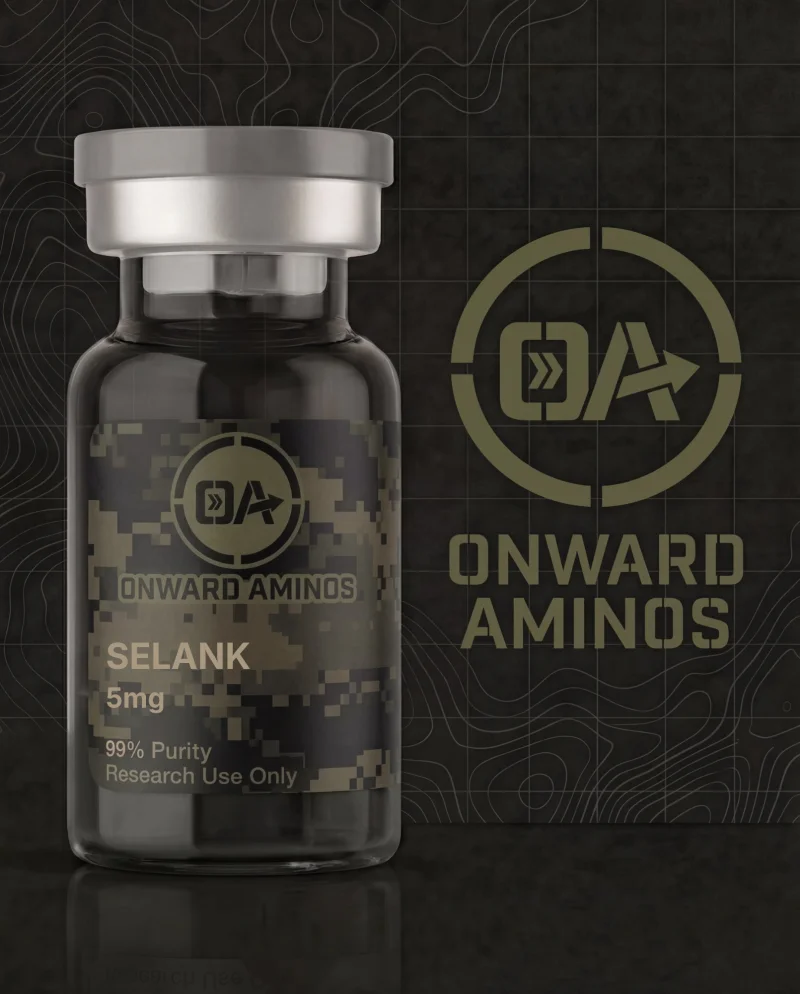
Selank is a synthetic heptapeptide studied in research for its effects on GABAergic signaling, serotonin neurotransmitter systems, and cognitive performance markers in animal and in vitro models. It is catalogued under CAS number 129954-34-3 with a molecular formula of C₃₃H₅₇N₉O₁₅ and a molecular weight of 751.86 g/mol. The compound is supplied as a lyophilized powder for laboratory research and is intended solely for research purposes, not for human use.
Selank belongs to a category of synthetic peptides derived from naturally occurring bioactive sequences, modified to improve metabolic stability for experimental use. Its development was oriented around extending the research utility of tuftsin — a naturally occurring tetrapeptide with characterized immunomodulatory properties — by engineering a structure that resists rapid enzymatic degradation in biological model systems. The resulting compound has a distinct pharmacological profile that is now studied independently of the parent tetrapeptide.
What is the molecular structure of Selank?
Selank has the amino acid sequence Thr-Lys-Pro-Arg-Pro-Gly-Pro — seven residues assembled through standard peptide bonds. Its molecular weight of 751.86 g/mol and formula C₃₃H₅₇N₉O₁₅ reflect this structure. The sequence has a logical architecture: the first four residues (Thr-Lys-Pro-Arg) correspond to the tuftsin parent tetrapeptide, while the appended three residues (Pro-Gly-Pro) constitute the stability-conferring extension introduced in synthesis.
Unlike lipidated metabolic peptides, Selank has no fatty acid modification. Its structural features are entirely peptidic. The Pro-Gly-Pro extension significantly increases resistance to enzymatic cleavage by the peptidases that rapidly degrade native tuftsin in biological systems. This stability difference is what makes Selank a distinct research tool — native tuftsin has a half-life in biological fluids too short for most experimental designs that require sustained activity, while Selank maintains presence in model systems over timeframes compatible with standard assay formats. Research-grade material is characterized to a purity of 99%+ by HPLC.
What is the relationship between Selank and tuftsin?
Tuftsin is a naturally occurring tetrapeptide (Thr-Lys-Pro-Arg) first characterized as a proteolytic fragment of the heavy chain of immunoglobulin G. Research on tuftsin has historically examined its immunomodulatory properties — specifically, stimulatory effects on macrophage, monocyte, and neutrophil function in vitro and in animal models. However, native tuftsin undergoes rapid cleavage by aminopeptidase N and other peptidases, limiting its experimental half-life in biological systems.
Selank appends Pro-Gly-Pro to the C-terminus of tuftsin. This tripeptide extension is known to confer stability against peptidase activity, extending the compound's effective presence in biological model systems without altering the core sequence. As published research with the modified compound accumulated, investigators identified pharmacological properties in Selank that were not apparent in studies with the parent tetrapeptide — particularly effects on GABAergic neurotransmission and serotonergic pathways that have become the central focus of the contemporary research literature on this compound.
What does published research describe about Selank's mechanisms?
Published research on Selank describes activity in two primary mechanistic domains: GABAergic neurotransmission and monoamine neurotransmitter systems, with serotonin as the most investigated target. In experimental animal models, Selank has been studied for effects on GABA-A receptor signaling. GABA-A receptors are ligand-gated ion channels that mediate inhibitory neurotransmission in the central nervous system, and they are the target class acted on by benzodiazepines, barbiturates, and related pharmacological tools. Published research describes Selank modulating GABAergic tone in animal models through mechanisms that differ at the receptor level from classical benzodiazepine binding.
In parallel, studies have examined Selank's effects on serotonin system activity — specifically, research characterizing changes in serotonin metabolism, the expression of enzymes involved in serotonin biosynthesis, and serotonin reuptake transporter activity in brain tissue preparations from animal models. Some published work additionally describes effects on brain-derived neurotrophic factor (BDNF) expression in experimental systems, though the mechanistic pathway linking Selank to BDNF regulation remains under active investigation in the research literature.
Onward Aminos does not make therapeutic or clinical claims about Selank. The compound is studied for its effects on these receptor and signaling systems in preclinical and in vitro research settings.
How does Selank's mechanism compare to classical reference compounds in research models?
Research on Selank explicitly positions it against classical anxiolytic reference compounds in standard experimental assays. Classical benzodiazepines act as positive allosteric modulators at the benzodiazepine binding site on the GABA-A receptor, increasing the frequency of chloride channel opening in response to GABA. Published research investigating Selank's mechanism suggests a different interaction profile — modulation of GABAergic tone through pathways that do not involve direct positive allosteric modulation at the benzodiazepine site.
This comparison is framed for research characterization. The mechanistic differences make Selank a distinct tool for investigating GABAergic and serotonergic signaling rather than a pharmacological substitute for any drug class.
How does Selank compare to other cognitive research peptides in the catalog?
Selank and Semax are the two most-studied Russian-developed synthetic research peptides in the cognitive and nootropic category. Both were developed through academic research programs in Russia and appear in a substantial body of published literature examining peptide effects on cognitive function markers in animal models. They are distinct compounds with different sequences and different primary mechanistic profiles.
Semax (CAS 80714-61-0, available at /compounds/semax) is derived from the ACTH 4-10 fragment and is primarily studied for effects on BDNF expression and nerve growth factor signaling pathways. Selank is derived from tuftsin and is primarily studied for GABAergic and serotonergic modulation. Both compounds appear in research designs examining multiple neurotransmitter pathways, but they are not mechanistically interchangeable and should not be treated as equivalent research tools.
Onward Aminos also carries Epitalon, DSIP, and Pinealon in the cognitive and longevity categories for researchers studying adjacent mechanisms. DSIP (delta sleep-inducing peptide) in particular appears alongside Selank in some published research examining sleep architecture and GABAergic modulation in overlapping experimental systems.
How should Selank be stored and handled for research?
Selank is supplied as a lyophilized powder and is stored at −20°C to preserve structural integrity. As a fully peptidic compound without lipid modification, the primary stability challenges are moisture exposure, oxidative degradation, and temperature excursion rather than lipid chain breakdown. Research handling practices that support reproducibility include maintaining cold storage, limiting freeze-thaw cycles, and protecting the lyophilized material from ambient humidity.
The Pro-Gly-Pro extension that improves Selank's stability in biological systems does not translate into stability at elevated storage temperatures. The lyophilized form degrades with heat and moisture exposure on timescales relevant to shipping. A compound characterized at 99%+ purity at manufacture can arrive below specification if exposed to sustained ambient temperatures in transit.
This article does not provide reconstitution or preparation instructions. Handling protocols are determined by the researcher according to their experimental requirements and applicable regulations.
How does Onward Aminos source Selank?
Onward Aminos supplies Selank as a research-grade compound held to a purity specification of 99%+ by HPLC, with mass spectrometry identity confirmation on every batch. Each batch is documented with a Certificate of Analysis reflecting those analytical results.
Researchers can review specifications, available sizes, and pricing on the Selank product page, or browse the full catalog of research compounds at all compounds. All material is intended for laboratory research use only.
This compound is a research chemical intended for laboratory and scientific research purposes only. It is not a drug, supplement, or food, and is not intended to diagnose, treat, cure, or prevent any disease. Onward Aminos does not sell products intended for human use. Researchers are responsible for compliance with all applicable local, state, and federal regulations.
Stay in the loop
New compounds, research updates & exclusive subscriber deals.
 Skip to main content