 Skip to main content
FREE SHIPPING THRESHOLD$250 REMAINING
MK-IV SPEC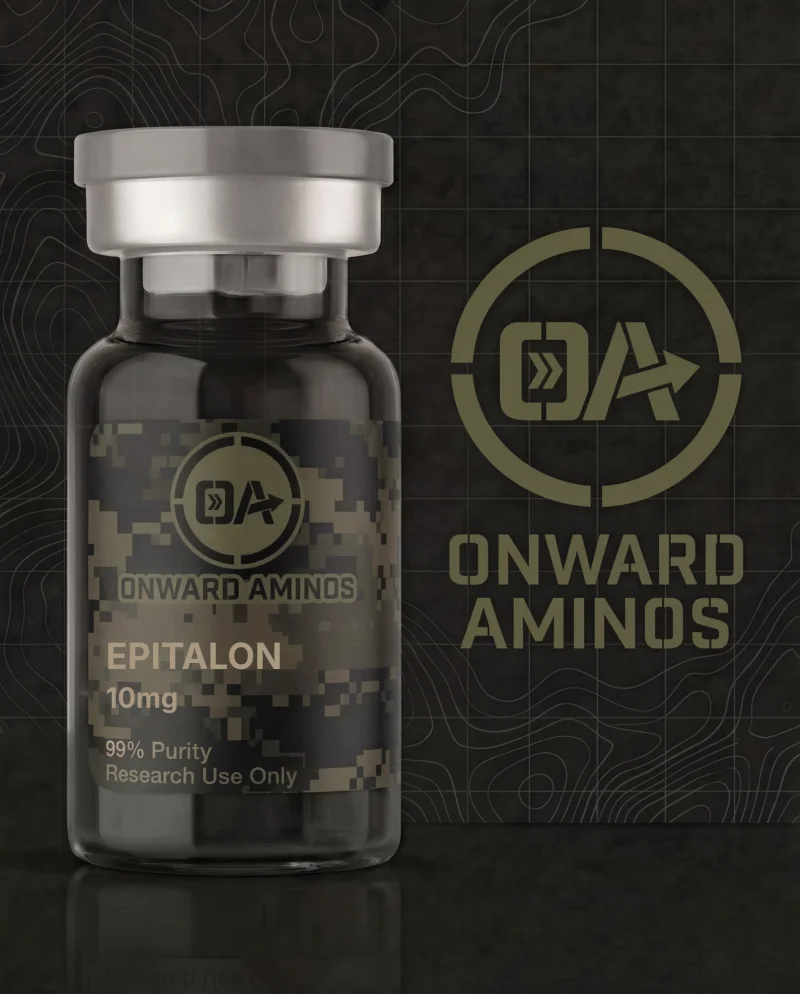
LAT: 34.0522° NLONG: 118.2437° W
RESEARCH ONLYOA-828-EPI
Epitalon
Tetrapeptide
UNIT COST$46.00
STATUSIN STOCK
SELECT MASS (MG)
In stock · Delivers in 7-10 days
QTY
1
MISSION CRITICAL: For in vitro laboratory research only. Not for human or veterinary use. Not evaluated by the FDA. Must be 21+.
SPECIFICATIONS
CAS No.307297-39-8
Mol. Weight390.35 g/mol
Purity99%+ (HPLC)
FormLyophilized Powder
Storage−20°C · Lyophilized
Mol. FormulaC14H22N4O9
COMPOUND INTEL
REF #OA-828-EPIMECHANISM_DUMP
MOLECULAR PROFILE
Epitalon (also known as Epithalon or Epithalamin) is a synthetic tetrapeptide derived from the pineal gland peptide Epithalamin. With the molecular formula C₁₄H₂₂N₄O₉ and a molecular weight of 390.4 g/mol (CAS: 307297-39-8), Epitalon consists of four amino acids (Ala-Glu-Asp-Gly) and mimics the endogenous peptide involved in melatonin regulation.
AMINO ACID SEQUENCE
Ala-Glu-Asp-GlyTetrapeptideTelomerase ComplexTRH Receptors
MECHANISM OF ACTION
Telomerase ActivityhTERT gene expression
Epitalon has been shown to increase telomerase activity and elongate telomeres in human somatic cell cultures through hTERT upregulation.
Melatonin SynthesisArylalkylamine N-acetyltransferase
Research indicates Epitalon influences melatonin-producing enzyme expression in pineal gland cell models.
TECHNICAL DATA
- CAS No.
- 307297-39-8
- Mol. Formula
- C14H22N4O9
- Mol. Weight
- 390.35 g/mol
- Purity
- 99%+ (HPLC)
- Form
- Lyophilized Powder
- Storage
- −20°C · Lyophilized


Scientific Context