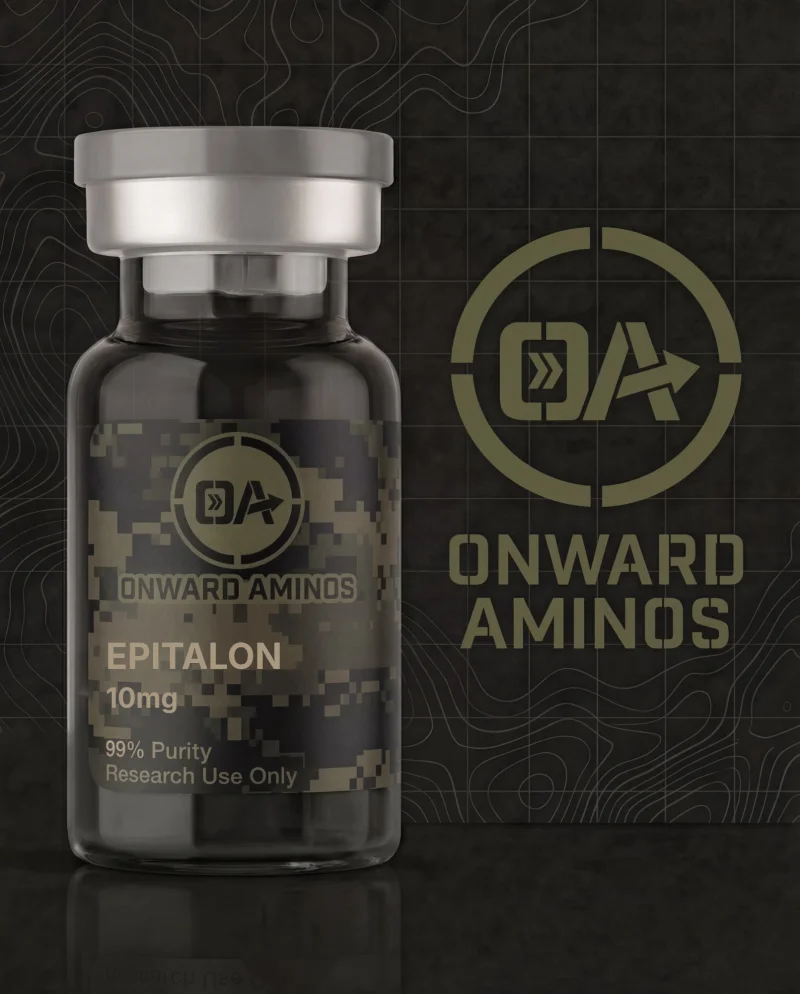
Epitalon is a synthetic tetrapeptide studied in research for its relationship to telomere regulation and pineal gland biology. It is catalogued under CAS number 307297-39-8 with a molecular formula of C₁₄H₂₂N₄O₉ and a molecular weight of 390.35 g/mol. The compound is supplied as a lyophilized powder for laboratory research and is intended solely for research purposes, not for human use.
Epitalon occupies a distinctive position in the longevity and cellular aging research literature because of its small size relative to the complexity of the mechanisms under investigation. At four amino acids, it is among the smallest synthetic research peptides that have generated sustained interest across multiple decades of published research. That research interest traces directly to its origins in the study of the naturally occurring pineal gland extract epithalamin.
What is the molecular structure of epitalon?
Epitalon is a tetrapeptide with the amino acid sequence Ala-Glu-Asp-Gly — alanine, glutamic acid, aspartic acid, and glycine, connected through standard peptide bonds. Its molecular weight of 390.35 g/mol reflects this compact architecture: four residues, no lipidation, no unusual modifications. The molecular formula C₁₄H₂₂N₄O₉ accounts for the backbone nitrogen and oxygen content alongside the side chains of the four constituent amino acids.
The compact structure has implications for research handling. Unlike lipidated metabolic peptides — where an attached fatty acid chain introduces additional oxidation sensitivity — epitalon's stability challenges are primarily moisture- and temperature-driven. The lyophilized form is a white powder characterized to a purity specification of 99%+ by HPLC. Mass spectrometry identity confirmation is performed on each batch to verify the correct molecular mass, since the small size of the molecule means any truncation or modification is detectable at the molecular weight level.
What is the relationship between epitalon and epithalamin?
Epithalamin is a naturally occurring polypeptide extract derived from the bovine pineal gland. Research on epithalamin — originating largely from Soviet-era and Russian academic research programs in the 1970s through 1990s — examined its effects on cellular aging, circadian regulation, and neuroendocrine function in animal models. The extract is a complex mixture rather than a defined single-sequence compound, which limits the precision of mechanistic research conducted with it.
Epitalon was synthesized as the defined active tetrapeptide fraction of epithalamin. The hypothesis was that the Ala-Glu-Asp-Gly sequence represented the primary biologically relevant component of the larger, compositionally variable extract. Synthesizing the sequence as a defined compound enabled mechanistic experiments with precise control over concentration and composition — conditions that are impossible with a complex extract of variable batch-to-batch composition.
Published research on epitalon generally studies the synthetic tetrapeptide rather than the parent epithalamin extract. This convergence on the synthetic form is why epitalon is the compound that appears most frequently in the telomere biology literature, while epithalamin is more common in older reference work.
What does published research describe about epitalon and telomere biology?
Published research on epitalon focuses primarily on telomerase activity and telomere dynamics in cell culture models. Telomeres are the repetitive nucleotide sequences that cap chromosome ends, protecting them from end-joining events and degradation during replication. With each cell division cycle, telomere length decreases incrementally — a process associated with cellular senescence in replicative aging models. Telomerase is the ribonucleoprotein enzyme capable of elongating telomeres by extending the repetitive sequence.
Published research describes epitalon stimulating telomerase activity in somatic cell culture models, including fibroblast and epithelial cell lines. Studies have measured telomere length by standard molecular biology assays before and after epitalon treatment in these systems, examining whether the telomerase stimulation translates to detectable changes in telomere length under controlled experimental conditions. This research is framed at the cellular and molecular level — enzyme activity, telomere length quantification — rather than at the clinical outcome level.
Onward Aminos does not make therapeutic claims about epitalon. The research interest is in its effects on telomerase and telomere dynamics in controlled laboratory models. Published research on these mechanisms does not constitute evidence of clinical efficacy in any human indication.
What other mechanisms are studied in epitalon research?
Beyond telomere biology, published research has examined epitalon in the context of pineal gland physiology and circadian regulation. Because epithalamin — the parent extract — is pineal-derived, researchers have investigated whether the active tetrapeptide retains effects on melatonin biosynthesis and secretion. Studies in animal models have characterized epitalon's effects on pinealocyte activity and the downstream melatonin output in these systems.
A parallel line of research has investigated epitalon in the context of oxidative stress markers in cellular systems. Some experimental work describes modulation of reactive oxygen species levels and antioxidant enzyme activity in cell culture models treated with epitalon. These are mechanistic studies examining molecular outcomes in controlled experimental conditions, not clinical evidence.
Research comparing epitalon to other peptides in the longevity and cellular aging category has also appeared in the literature. The compound is sometimes studied alongside Pinealon — another synthetic peptide derived from pineal gland research — in experimental designs that examine multiple regulatory mechanisms in the same model system. Onward Aminos carries Pinealon in the catalog for researchers studying these overlapping areas.
How does epitalon compare to other longevity research peptides?
Epitalon is frequently grouped with a class of compounds sometimes described as bioregulator peptides — short synthetic sequences studied for effects on gene expression, cellular aging mechanisms, and tissue-specific regulatory pathways. These are distinct from larger hormonal or metabolic peptides like the GLP class and from structural or cytoskeletal research tools.
Property
Epitalon
Pinealon
CAS number
307297-39-8
175175-23-2
Source association
Pineal gland (epithalamin fraction)
Pineal gland (polypeptide extract)
Molecular weight
390.35 g/mol
418.41 g/mol
Sequence length
4 amino acids (Ala-Glu-Asp-Gly)
3 amino acids
Primary research focus
Telomerase / telomere regulation
Neuroprotection / oxidative stress
Catalog category
Longevity
Cognitive
The comparison is framed for research characterization, not clinical recommendation. Both are research peptides studied in controlled experimental systems and are not intended for human use.
What is known about epitalon's stability and handling in research?
Epitalon is supplied as a lyophilized powder and is stored at −20°C to preserve structural integrity. Unlike lipidated peptides, epitalon does not carry a fatty acid moiety subject to lipid oxidation. The primary stability concerns are moisture exposure, temperature excursion, and repeated freeze-thaw cycling, all of which can promote hydrolysis and oxidation of the peptide backbone.
Research handling practices that support reproducibility include maintaining cold storage, minimizing freeze-thaw exposure, and protecting lyophilized material from humidity with appropriate desiccant storage. The compact structure of the tetrapeptide does not confer inherent stability at ambient temperatures — the lyophilized powder degrades under thermal stress on a timescale relevant to multi-day shipping.
This article does not provide reconstitution or preparation instructions. Handling protocols are determined by the researcher according to their experimental requirements and applicable regulations.
How does Onward Aminos source epitalon?
Onward Aminos supplies epitalon as a research-grade compound held to a purity specification of 99%+ by HPLC, with mass spectrometry identity confirmation on every batch. Each batch is documented with a Certificate of Analysis. For how to retain and organize that documentation so it stays audit-ready, see COA recordkeeping.
Researchers can review specifications, available sizes, and pricing on the epitalon product page, or browse the full catalog of research compounds at all compounds. All material is intended for laboratory research use only.
This compound is a research chemical intended for laboratory and scientific research purposes only. It is not a drug, supplement, or food, and is not intended to diagnose, treat, cure, or prevent any disease. Onward Aminos does not sell products intended for human use. Researchers are responsible for compliance with all applicable local, state, and federal regulations.
Stay in the loop
New compounds, research updates & exclusive subscriber deals.
 Skip to main content